
The International Journal of English Literature and Social Sciences (IJELS) follows a rigorous peer-review process as a quality control mechanism to ensure the publication of high-quality, original, and impactful research. Submitted manuscripts are evaluated by subject experts who assess the originality, relevance, methodology, and overall contribution of the work. While reviewers provide recommendations, the final decision regarding acceptance or rejection rests solely with the journal’s editorial board.
IJELS strictly follows a double-blind peer-review process, ensuring that the identities of both authors and reviewers remain confidential throughout the evaluation. This approach minimizes bias and promotes objective assessment. Each manuscript is typically reviewed by a minimum of two independent experts in the relevant field. Reviewers are selected based on their academic expertise, research background, and prior reviewing experience.
The journal maintains a diverse and qualified pool of reviewers from reputed academic institutions and research organizations worldwide. In addition to the existing reviewer database, potential reviewers may be identified through references cited in the manuscript or through professional academic networks, conferences, and scholarly collaborations. Reviewers evaluate submissions based on originality, clarity, methodological rigor, and contribution to the discipline, and provide constructive feedback to enhance the quality of the manuscript.
Based on reviewers’ comments and editorial evaluation, the following decisions may be made:
- Acceptance: The manuscript is accepted without any changes and published in its original form.
- Minor Revision: The manuscript is accepted subject to minor corrections before publication.
- Major Revision: The manuscript requires substantial revisions and will be reconsidered after resubmission.
- Revise and Resubmit: The manuscript is not accepted in the current round but may be reconsidered after significant improvements.
- Rejection: The manuscript is not suitable for publication and will not be reconsidered.
This structured and transparent peer-review process ensures the integrity, credibility, and academic excellence of all publications in IJELS.
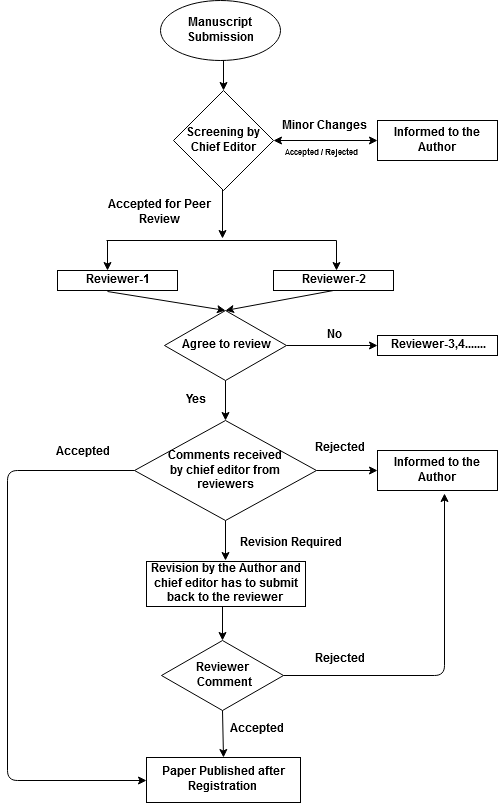
Paper Publishing Process (Double Blind Peer Review)
1. Manuscript Submission: The process starts when the author submits the manuscript through the journal’s online portal or via email. Along with the paper, supporting documents such as a cover letter, copyright agreement, and supplementary materials are provided. The submission is checked for adherence to formatting guidelines, correctness of references, and compliance with plagiarism norms.
2. Initial Screening (Desk Review): The editorial team or Chief Editor conducts a preliminary evaluation to verify that the manuscript fits the journal’s scope, meets basic quality standards, and demonstrates originality. Based on this review, the paper is either declined or moved forward to the peer review stage.
3. Assignment to Reviewers: Manuscripts that pass the initial screening are forwarded to two to four subject experts. Reviewers are selected carefully to ensure relevant expertise and an unbiased assessment, and invitations are sent requesting their participation.
4. Reviewer Acceptance: Invited reviewers indicate whether they are willing to evaluate the manuscript. If any reviewer declines due to time constraints or conflicts of interest, alternative reviewers are appointed to maintain continuity in the process.
5. Peer Review Process: Accepted reviewers conduct a detailed assessment of the manuscript, focusing on originality, research significance, methodology, clarity, organization, referencing, and ethical standards. They then submit their observations and recommendations, which may include acceptance, revision (minor or major), or rejection.
6. Editorial Decision Based on Reviews: The Chief Editor examines the reviewers’ feedback and makes a decision accordingly. The outcome—acceptance, revision request, or rejection—is communicated to the author with consolidated comments.
7. Author Revision: When revisions are required, the author updates the manuscript in line with reviewer suggestions and prepares a detailed response explaining how each comment has been addressed before resubmission.
8. Re-Review (if required): For substantial revisions, the updated manuscript may be returned to the reviewers for further evaluation. This step ensures that all concerns have been properly resolved and may involve multiple review cycles if necessary.
9. Final Acceptance: Once the manuscript satisfies all academic and editorial requirements, it is formally accepted for publication, and the author receives an official confirmation.
10. Proofreading & Formatting: The accepted paper undergoes copyediting and formatting to meet the journal’s publication standards. Authors may review proofs to correct any minor errors before finalization.
11. Registration / APC Payment (if applicable): Authors complete any required registration procedures and, where applicable, pay the Article Processing Charges (APC) as per the journal’s policies.
12. Publication: The finalized article is published online and/or in print, assigned a DOI, and may be indexed in academic databases to enhance its reach and visibility.
13. Post-Publication: After publication, the article becomes available for reading, citation, and academic use, contributing to ongoing research and scholarly discourse.
 Submit Your Paper Now!!
For Authors









- Current Conferences
- RSS Feed Complete Issue

- Call for Papers

- Author Guidelines
- Peer Review Process
- Privacy Policy
- Publication Policies and Ethics
- Open Access Policy
- Indexing and Archiving
- Submit Manuscript Online
- How to Publish with Us?
- Current Issue
- Archive Issue
- Complete Issue
- Track Paper
- Download Formats
- Join Us
- Blog
Important Links